

- Focus and Scope
- Section Policies
- Peer Review Process
- Publication Frequency
- Open Access Policy
- Archiving
- Publication Ethics and Malpractice Statement
Focus and Scope
The journal welcomes submissions on a wide range of branches of Humanities, Arts and Social Studies. The journal covers a variety of issues including:
- Humanities: Archaeology and Anthropology; History and Philosophy; Language, Linguistics and Literature; Asian Studies
- Arts: Architecture; Fine and Applied Arts
- Social Sciences: Education; Communication and Media; Management; Social Sciences
SSRH publishes articles in the following categories:
- Research articles: Full reports of research projects including background, theoretical frameworks, methodology and data, results and discussion.
- Review articles: Articles which provide a comprehensive summary or review on a certain topic and a perspective on the state of related fields. Review articles are usually by invitation from the journal’s editorial team. However, independent submissions are also welcome.
Section Policies
Articles
 Open Submissions Open Submissions |
Indexed |
Peer Reviewed |
Peer Review Process
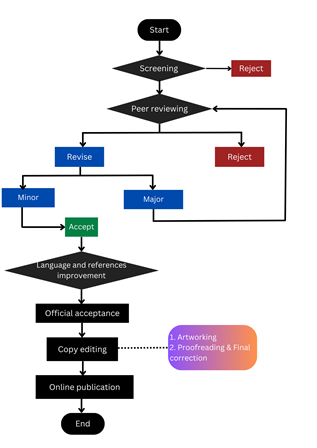
All articles submitted to be published in SSRH are processed in 8 steps as follows:
1. Screening: The editor-in-chief, in consultation with other members of the editorial board, decides whether to accept the submitted manuscript for the reviewing process. The manuscript will be rejected if it contains similarities of more than 20% or of more than 30% proportion of AI-generated texts or the content does not reflect the journal’s aim and scope.2. Peer reviewing: A manuscript that has passed the screening stage must be blindly reviewed at least by two reviewers affiliated to different institutions from each other and from the author(s). The reviewers are selected by the Editor-in-Chief with the help of some other members of the editorial board.
3. Notification of the peer reviewing results: After receiving the results of the peer-reviewing, the author(s) will receive notification of the results together with any comments and suggestions made by the editor(s) and reviewers. There are two categories of results: Revise and Reject.
4. Revision: After receiving the peer-review results and feedback from the journal, the author(s) of an article accepted on the condition of revision must revise the manuscript according to the attached comments and suggestions and send back the revised version with an explanation on the correction page. The author(s) will be given 1 month to revise the manuscript. In the case of acceptance with major revisions, the revised article must be reviewed again by one or two reviewers upon the decision of the editorial team.
5. Language and references improvement: The author(s) of the accepted manuscript will be asked to submit a manuscript that has been proofread by a qualified native English speaker or a professional language editing service. Additionally, the author(s) should check both in-text citations and the references section to ensure compliance with APA style.
6. Official acceptance: The editor-in-chief considers the revised manuscript.
7. Copy editing
- Artworking: Officially accepted manuscripts will be formatted as an artwork and proofread by the journal.
- Proofreading & final correction: The author(s) will be asked to check artwork before publication. Content revisions are no longer permitted during this stage
Please note that the Editorial Team has the right to decide in which issue the submitted manuscripts will be published. The decision is to be made upon the distribution of research topics as well as affiliation and country of the authors. The Letter of Acceptance issued will not give the date and issue of publication.
Publication Frequency
Social Sciences Review and Humanities was published regularly twice a year, in June and December.
Open Access Policy
Social Sciences Review and Humanities (SSRH) is an open access journal which provides immediate, worldwide, barrier-free access to the full text of all published articles without charge readers or their institutions for access. Readers have right to read, download, copy, distribute, print, search, or link to the full texts of all articles in IJRS. This journal provides immediate open access to its content on the principle that making research freely available to the public supports a greater global exchange of knowledge.
Archiving
This journal utilizes the LOCKSS system to create a distributed archiving system among participating libraries and permits those libraries to create permanent archives of the journal for purposes of preservation and restoration. More...
Publication Ethics and Malpractice Statement
Social Sciences Review and Humanities is a journal aims to be a leading peer-reviewed platform and an authoritative source of information. We publish original research papers, review articles and case studies focused on foreign language as well as related topics that has neither been published elsewhere in any language, nor is it under review for publication anywhere. This following statement clarifies ethical behavior of all parties involved in the act of publishing an article in this journal. This statement is based on COPE’s Best Practice Guidelines for Journal Editors.
Duties of Authors
- Reporting Standards: Authors should present an accurate account of the original research performed as well as an objective discussion of its significance. Researchers should present their results honestly and without fabrication, falsification or inappropriate data manipulation. A manuscript should contain sufficient detail and references to permit others to replicate the work. Fraudulent or knowingly inaccurate statements constitute unethical behavior and are unacceptable. Manuscripts should follow the submission guidelines of the journal.
- Originality and Plagiarism: Authors must ensure that they have written entirely original work. The manuscript should not be submitted concurrently to more than one publication unless the editors have agreed to co-publication. Relevant previous work and publications, both by other researchers and the authors’ own, should be properly acknowledged and referenced. The primary literature should be cited where possible. Original wording taken directly from publications by other researchers should appear in quotation marks with the appropriate citations.
- Multiple, Redundant, or Concurrent Publications: Author should not in general submit the same manuscript to more than one journal concurrently. It is also expected that the author will not publish redundant manuscripts or manuscripts describing same research in more than one journal. Submitting the same manuscript to more than one journal concurrently constitutes unethical publishing behavior and is unacceptable. Multiple publications arising from a single research project should be clearly identified as such and the primary publication should be referenced
- Acknowledgement of Sources: Authors should acknowledge all sources of data used in the research and cite publications that have been influential in determining the nature of the reported work. Proper acknowledgment of the work of others must always be given.
- Authorship of the Paper: The authorship of research publications should accurately reflect individuals’ contributions to the work and its reporting. Authorship should be limited to those who have made a significant contribution to conception, design, execution or interpretation of the reported study. Others who have made significant contribution must be listed as co-authors. In cases where major contributors are listed as authors while those who made less substantial, or purely technical, contributions to the research or to the publication are listed in an acknowledgement section. Authors also ensure that all the authors have seen and agreed to the submitted version of the manuscript and their inclusion of names as co-authors.
- Disclosure and Conflicts of Interest: All authors should clearly disclose in their manuscript any financial or other substantive conflict of interest that might be construed to influence the results or interpretation of their manuscript. All sources of financial support for the project should be disclosed.
- Fundamental Errors in Published Works: If the author discovers a significant error or inaccuracy in the submitted manuscript, then the author should promptly notify the journal editor or publisher and cooperate with the editor to retract or correct the paper.
- Hazards and Human or Animal Subjects: The author should clearly identify in the manuscript if the work involves chemicals, procedures or equipment that have any unusual hazards inherent in their use
Duties of Editor
Publication Decisions: Based on the review report of the editorial board, the editor can accept, reject, or request modifications to the manuscript. The validation of the work in question and its importance to researchers and readers must always drive such decisions. The editors may be guided by the policies of the journal's editorial board and constrained by such legal requirements as shall then be in force regarding libel, copyright infringement and plagiarism. The editors may confer with other editors or reviewers in making this decision. Editors have to take responsibility for everything they publish and should have procedures and policies in place to ensure the quality of the material they publish and maintain the integrity of the published record.
Review of Manuscripts: Editor must ensure that each manuscript is initially evaluated by the editor for originality. The editor should organize and use peer review fairly
Social Sciences Review and Humanities
Published by HAQI Publishing Service
Managed by Publikasi Ilmiah HAQI Publishing Service
Address: Khatib Sulaiman Street, Padang, West Sumatera,
Website: https://journal.haqipub.com/index.php/ssrh/index
 This work is licensed under a Creative Commons Attribution 4.0 International License.